
 Baby Sleep


 The short answer


1Three months is a transition stage
Around 6 to 12 weeks, many babies begin showing more day-night organization. Night sleep may lengthen, wake periods may become more predictable, and parents may start seeing patterns that were invisible in the first weeks.
Still, a 3-month-old is not an older baby in miniature. Sleep cycles are short, daytime naps vary, and night feeds can remain normal. A chart should guide observation, not create panic.

2Use wake windows gently
Wake windows can help prevent overtiredness, but exact numbers are not medical rules. Watch the baby, then compare sleepy cues with the clock. If the last nap was short, the next wake window may need to be shorter.
A practical day often includes 3 to 5 sleep episodes, depending on nap length, morning wake time, feeding, and temperament. The last part of the day usually needs the most flexibility.

3Build day-night contrast
Use normal household light and interaction during the day. At night, keep feeds and changes calm, dim, and efficient. This supports the maturing circadian system without forcing the baby to behave like an older infant.
A short bedtime routine can begin now: diaper, feed, sleep sack if appropriate, dim room, song or phrase, and safe sleep space.

4Skip formal crying-based training
There is not strong direct evidence supporting structured Ferber-style methods for 3-month-olds. Responsive settling fits this age better: help the baby calm, and only reduce help gradually if your baby is clearly ready.
Feeding should remain responsive. Do not remove night feeds simply to make a schedule look cleaner, especially if growth, prematurity, or feeding concerns are present.

Quick reference
Sleep range
Often 14-17 hours
Total sleep varies by baby and measurement
Naps
3-5 episodes
Short naps can still be normal
Night feeds
Often normal
Follow feeding and growth needs
Routine focus
Day-night cues
Bright days, quiet nights


Example day
Morning
Sleep range
Total sleep varies by baby and measurement
Uses often 14-17 hours as context for the next plan.
First nap
Naps
Short naps can still be normal
Uses 3-5 episodes as context for the next plan.
Midday
Night feeds
Follow feeding and growth needs
Uses often normal as context for the next plan.
Evening
Routine focus
Bright days, quiet nights
Uses day-night cues as context for the next plan.
 Uses often 14-17 hours as context for the next plan.
Common challenges
Bedtime becomes harder after a late final nap.
 Bedtime becomes harder after a late final nap.
- Likely reason
- Sleep pressure may be too low or the last window may be off.
- Try first
- Protect the bedtime anchor and adjust the final nap.
- How to check
- Watch bedtime settling time for several evenings.
Night wakings increase suddenly.
- Likely reason
- Schedule, feeding, illness, development, or environment may have changed.
- Try first
- Review sleep, feeds, symptoms, and room conditions together.
- How to check
- Look for the same pattern across 3-7 days.
Plan for today
- 1
Track naps and night sleep for several days.
- 2
Use sleepy cues and wake windows together.
- 3
Keep every sleep space safe and empty.
- 4
Use responsive settling instead of structured crying intervals.
Quick routine checklist
How Yorix helps at 3 months
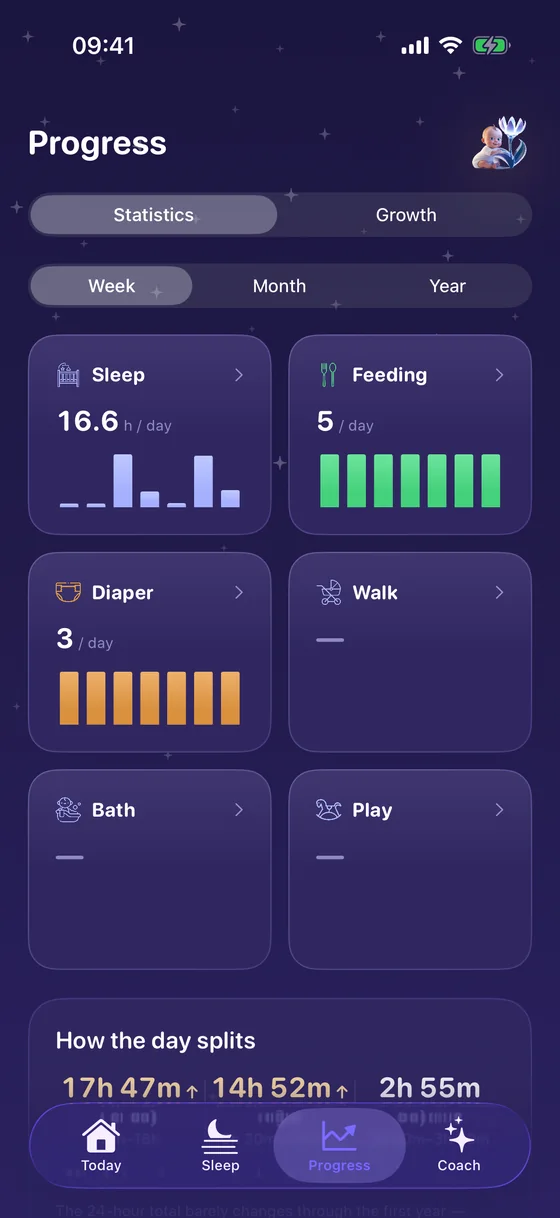
Yorix tracks the short naps, feeds, wake windows, and night wakings that make 3 months feel hard to read. After a few days, the app can suggest a calmer next nap window based on your baby’s real pattern.
That means less mental math and a schedule that bends when one nap goes sideways.
Common questions
How many naps should a 3-month-old take?
Many 3-month-olds take 3 to 5 naps, but nap length varies. Total sleep, mood, feeding, and bedtime matter more than a perfect nap count.
Why does my 3-month-old wake after 40 minutes?
Short naps can reflect sleep-cycle transitions. They are common at this age, especially when the baby is still learning to connect cycles.
 Turn insights into better days